


Your shopping cart is empty!
Sweet pepper "Rewia"
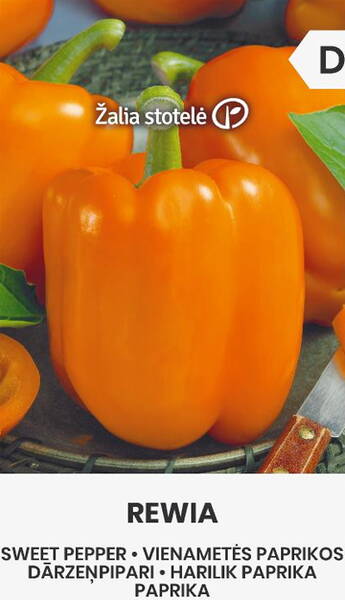
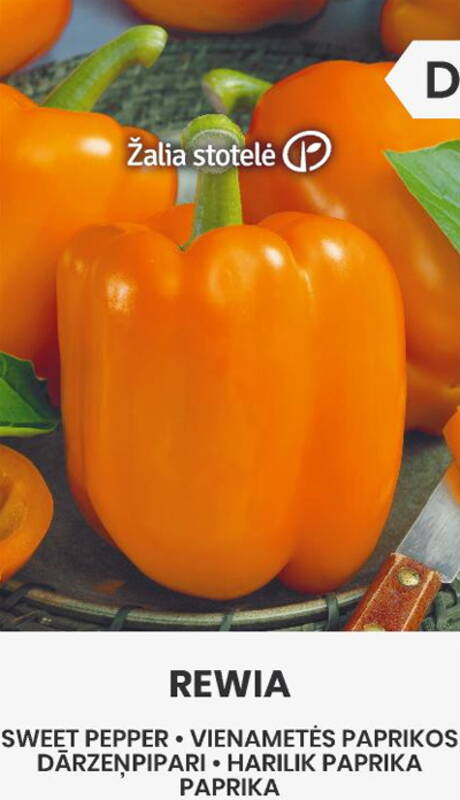
Sweet Pepper "Rewia".
Dark orange flesh is juicy and very sweet.
Early ripening variety (period from germination to technical ripeness is 95-100 days) for cultivation in open ground and film shelters.
The plant is semi-determinate, semi-spreading, 50-60 cm high. The fruit is blocky (cube-shaped), 10 cm long, 9 cm in diameter.
The colour in technical ripeness is green, in biological ripeness – orange. Wall thickness 6-7 mm. The flesh is juicy and very sweet. Average fruit weight 140-160 g.
The variety is distinguished by good fruit setting and uniform ripening.
Recommended for fresh consumption, home cooking, canning, and freezing.
Sowing for seedlings in early March. Pricking out in the cotyledon phase. Planting in the ground at the end of May. Grows well on fertile, moist, warm, humus-rich, cultivated, non-acidic (pH 6.5) sandy or light loamy soil. During the fruiting period, sweet peppers should be watered abundantly 2–3 times a week, preferably before noon.
Pruning: removal of all side shoots and leaves up to the first fork (branching point).
Dark orange flesh is juicy and very sweet.
Early ripening variety (period from germination to technical ripeness is 95-100 days) for cultivation in open ground and film shelters.
The plant is semi-determinate, semi-spreading, 50-60 cm high. The fruit is blocky (cube-shaped), 10 cm long, 9 cm in diameter.
The colour in technical ripeness is green, in biological ripeness – orange. Wall thickness 6-7 mm. The flesh is juicy and very sweet. Average fruit weight 140-160 g.
The variety is distinguished by good fruit setting and uniform ripening.
Recommended for fresh consumption, home cooking, canning, and freezing.
Sowing for seedlings in early March. Pricking out in the cotyledon phase. Planting in the ground at the end of May. Grows well on fertile, moist, warm, humus-rich, cultivated, non-acidic (pH 6.5) sandy or light loamy soil. During the fruiting period, sweet peppers should be watered abundantly 2–3 times a week, preferably before noon.
Pruning: removal of all side shoots and leaves up to the first fork (branching point).
* Forming a pepper bush and obtaining your own seeds.
To form a compact bush with well-developed side shoots, it is necessary to remove the top of the main stem (pinch) when the pepper plant reaches a height of 20-25 cm. Pinched plants will quickly begin to branch. Of all the shoots that appear, only the top 4-5 (laterals) are left, and the rest are removed. The crop will form on the remaining shoots. At the same time, 10-14 fruits are left on pepper plants. In hot, humid weather, removal of side shoots (suckers), especially the lower ones, is a mandatory measure, and vice versa, in hot, dry summers, plants are not pruned. Insufficient pollination of flowers can cause the appearance of substandard (deformed) fruits. To prevent this, artificial supplementary pollination of flowering plants should be applied, i.e., in hot, sunny, calm weather, gently shake the plants.
Attention! Sweet and hot peppers are planted in a permanent place separately from each other, i.e., on different beds, as they are capable of cross-pollination, and the sweet pepper fruits will then acquire bitterness...
To obtain pepper seeds, take ripe red or bright yellow fruits (depending on the variety), cut them in a circle near the calyx, and then take out the seed core (placenta) with seeds by the stalk. The seed cores are dried (3-4 days) at a temperature of +25+30°C and the seeds are separated. They are put in a paper bag and stored in a warm, dry place for 5-6 years.
Pepper pests.
Aphids — the most dangerous pest that causes huge damage to this crop. Aphids appear on leaves, stems, flowers, and feed on plant juices.
Control measures: treatment of plants with suitable insecticides. Spray before and after flowering. Do not treat during fruiting. Of the folk remedies, the following solution is used: pour a glass of wood ash and a glass of tobacco dust into a bucket, then pour hot water and leave for a day. Before spraying, the solution is stirred well, filtered, and a tablespoon of liquid soap is added. Spray plants in the morning.
Spider mite — sucks juice from the underside of the leaf.
Try treating the pepper with the following solution. Take a glass of garlic passed through a meat grinder and a glass of dandelion leaves, a tablespoon of liquid soap, and dilute in 10 litres of water. Strain, separating the pulp, and spray the plants at any stage of development.
Slugs — not only eat leaves but also damage fruits, which subsequently rot.
Control measures: keep the plantings clean, dust the grooves around the garden bed with freshly slaked lime or a mixture of lime, ash, and tobacco dust. In hot, sunny weather during the day, it is necessary to loosen the soil to a depth of 3-5 cm, then to scare off the pest, dust the soil with ground pepper (black or red) at the rate of one teaspoon per 1-2 m2 or dry mustard (1 teaspoon per 1 m2).
Shleta is an Algerian dish made from green sweet peppers.
It is common in the northern region of Algeria — Kabylia.
Shleta is a traditional North African dish, loved for its simplicity and fresh vegetables.
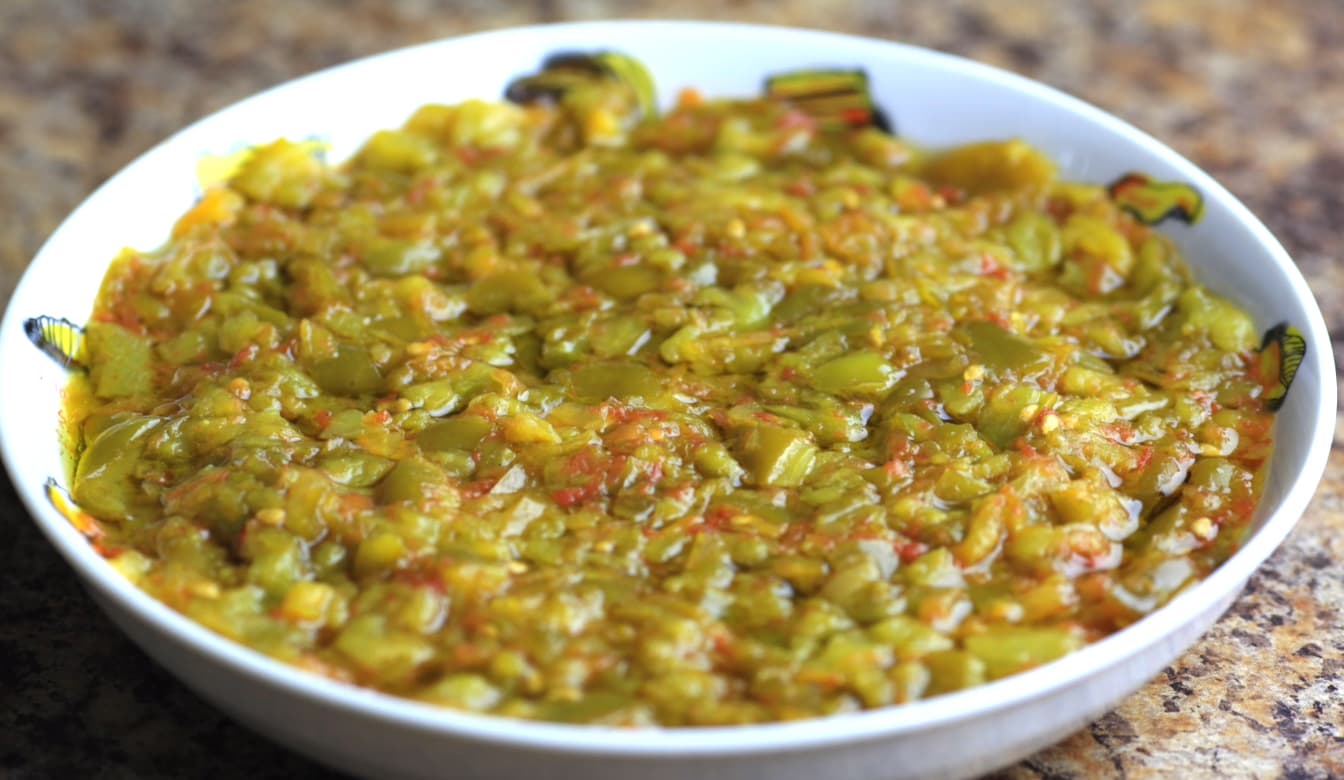
You will need:
- 6–7 green sweet peppers
- 3 tomatoes
- olive oil
- salt
- pepper
Clean the peppers and cut them in half. Press each half slightly to flatten it. Place the pepper halves on a grill rack or a skillet and char them lightly.
Then chop all the peppers into very small cubes.
Blend the tomatoes into a purée. You can also use canned tomatoes in their own juice. Add the chopped peppers and tomato purée to a hot pan.
Season with pepper and a little salt. Cover with a lid and simmer until the peppers are tender. Add a little olive oil, then continue cooking uncovered until the excess moisture evaporates.
Let the dish cool slightly, transfer it to a plate, and drizzle with olive oil. Shleta is traditionally eaten without cutlery — scooped up with pieces of white bread lightly toasted on the grill.
It turns out incredibly tasty.